- The Best Piano Vst Plugins
- Best Free Piano Vst Plugins
- Best Free Piano Vst Plugins For Ableton Live
- Best Piano Vst Plugin Fl Studio
- The Best Piano Vst Plugins
Virtual instruments are now more popular than ever, so we are checking out the best piano VST plugins available in 2020.
EastWest Quantum Leap Pianos is another amazing paid piano VST plugin that comes with four different sampled pianos. If you’re a fan of the Bechstein D-280, Steinway D, Bosendorfer 290, or Yamaha C7, you may just be a fan of this plugin as well. The 4Front piano is a quality, full-bodied upright piano plugin and is great for capturing a live feel in your own productions. This one is also a lot more ‘lively-sounding’ than the other options out there, likely due to the fact that it’s a physically-modeled piano, rather than sampled.
- The best piano plugins are recorded in quite expensive studios. And if you're not a programmer, you would have to hire someone to help you out with all of the code that goes into your plugin. For that reason, people that go through all the work of making a piano plugin have a strong argument for putting a price tag on their creation.
- Many piano VST's are believed to seem more realistic than the piano motors found in computer workstations, etc. When you consider the processing capacity of high-quality PC's and Mac's, it is not surprising that several plugins may push the boundaries farther than a physical tool. In the following guide, Fidlar will record and review our Best Piano VST.
- With its unbelievable sound-shaping parameters, there is no wonder why Keyzone Classic is frequently advocated as a go-to free piano VST. Read More: Digital Piano Vs Keyboard 2020: Top Full Review, Guide. Best Piano VST 2020: Top Full Review & Guide. Best Piano Concertos 2020: Top Full Review & Guide. Versilian Studios Upright No.
Many piano VST’s are thought to sound more realistic than the piano engines found in keyboard workstations, etc. When you consider the processing power of high-quality PC’s and Mac’s, it’s no surprise that some plugins can push the boundaries further than a physical instrument. In this article, we will list and review our top piano plugins.
Here are the best piano VST plugins 2020:
1. Spectrasonics Keyscape
The ultimate piano VST plugin
Spectrasonics are giants of the virtual instrument world; their Omnisphere synth changed the way people think about VST’s. Now, they Keyscape Collector Keyboards VST is the benchmark for virtual pianos.
Keyscape is a collection of 36 stunning keyboard instruments, ranging from a beautiful grand piano to a more obscure harmochord. In between the conventional and the obscure, there are gorgeous Rhodes, Wurlitzer’s, Clavinet’s, and much more. Even more impressive than the instrument lineup is the meticulous attention to detail in finding, restoring, and recording these rare instruments.
Each instrument has lots of variations, for example, the flagship Yamaha C7 Grand Piano has rock, classical, cinematic, amongst others. Each variation suits different styles of playing or musical genres.
The user interface is well laid out and easy to use. There are two windows on the left; the upper window is where you choose your instrument, and the lower window is where you select your style variation. Once you have selected a keyboard, the main window will show a nice image of it, underneath which you will find a range of relative controls, like reverb, performance noise, EQ, etc.
To get the most out of your performance, Keyscape has a broad range of velocity curve settings that are optimized for the most popular controller keyboards.
| Image credit: SpectrasonicsCheck Sweetwater |
|
In our book, Keyscape Collector Keyboards is the best piano VST plugin; it’s that simple. The fact that it was around 10 years in the making show the monumental amount of work that went into putting it together.
As a virtual grand piano, Keyscape’s LA Custom C7 is king. The beautiful C7 is incredibly articulate and crisp, with a low-end that almost makes you feel the weight under the keys. No other virtual piano has so much depth of character; no other VST is so responsive to your playing.
At this level, sounding nice isn’t enough; it’s about small details, and Spectrasonics do that better than anyone. All 36 keyboard instruments are of the same impeccable quality; that’s why Keyscape is our highest-rated piano VST plugin. Try it with a top-quality keyboard controller, and it will blow you away.
2. Garritan CFX Concert Grand
The sound of Abbey Road Studios
When you think about Yamaha grand pianos, the 9-foot CFX concert grand is as good as it gets. Now, place that CFX concert grand in Abbey Road Studio One, and you have a match made in heaven. That is precisely what Garritan did.
The Yamaha CFX concert grand piano is world-renowned for its broad palette of tonal color. The acoustics of Abbey Road Studio One was the perfect place to capture all of that detail. It was done by using the very best microphones in the world in various positions to create lots of presets.
The presets are split into three categories, which are Classic, Contemporary, and Player, each with its unique microphone position. Within each category, there are numerous sub-presets to suit all styles. If we take a closer look, the Classic category is full of presets that range from Bach inspired classical settings to a Bill Evens themed jazz tone. So, it crosses different genres but remains in the classic era of each.
Contemporary provides amore modern mix of presets. It covers everything from dark and edgy soundtracksto Randy Newman style movie magic warmth. Both Classic and Contemporary are allabout the output and how the audience hears the CFX.
The Player category, onthe other hand, is all about the CFX itself. It’s full of presets that captureevery single noise and nuance of the CFX from right there on the bench. Thereare also a few alternate tuning presets that offer something a littledifferent.
Garritan put together an attractive user interface with just the right amount of content. It has enough tweaking options, whether it’s mic positions or mechanical noise, but not so much that it becomes tedious. It’s very playable right from the start.
| Image credit: GarritanCheck Sweetwater |
|
Deciding where to place this one on our list was quite tricky. It was always going to be near the top, but splitting this VST and Ivory II by Synthogy was difficult. In the end, we placed Garritan slightly ahead; the sound quality was close, but the lovely user interface won us over.
The Yamaha CFX concert grand is a genuine performers piano; it’s not tied to one genre. Garritan has delightfully captured all of that versatility through the extensive microphone positions. This piano is beautiful from top to bottom, but it’s the midrange that excels most. Play a simple major 7th root voicing anywhere in the mids, and you’ll be hooked.
3. Synthogy Ivory II Studio Grands
The most realistic grand piano emulator
Synthogy has been a leader in virtual piano software for many years, and some people still consider them to be the best. Their Ivory series has never failed to impress with its outstanding realism. This time, we are looking at the Ivory II Studio Grands plugin.
The plugin features two iconic grand pianos that were recorded in iconic studios. The first of the pianos is the Steinway Model B grand piano, one of the most recorded grand pianos in history. It was recorded at the legendary Power Station in New England with absolute precision.
The second instrument is the Bösendorfer 225 grand piano, which was recorded at the famed Firehouse Recording Studios in California. This specific VST has been used on multiple Grammy Award winning songs.
The thing that stands out most when you get the specs of Ivory II is that it boasts a 112 GB library. To think of the time involved in sampling those pianos to that extent is nothing short of spectacular. Each piano has up to 24 velocity layers and more release and soft pedal samples.
Ivory II was also the launch of an entirely new sound engine from Synthogy, the Ivory 2.5 Piano Engine. Apart from the improved sound, it comes with some new features like Shimmer, which gives more precise control over reverb and decay.
| Image credit: SynthogyCheck Sweetwater |
|
Synthogy are experts in this field; they have been doing it for a very long time and keep getting better. Ivory II takes two iconic pianos, and they have replicated them digitally with incredible accuracy. When you think about the sheer size of the library and the 24 velocity layers, you can imagine nothing is lost, every nuance of these instruments is at your fingertips.
The Steinway Model B is a stunning classical grand piano, it’s beautifully percussive, too. The Bösenndorfer 225 is the more versatile of the two, great for classical, but exceptional for jazz. Especially that bottom range that Oscar Peterson made famous with his ostinato bass lines.
The interface lets it down slightly, while it offers a lot of tweaking possibilities, it looks very dated and isn’t as intuitive as it should be. When it comes to sound alone, Ivory II might be the most realistic piano VST available.
4. Native Instruments The Gentleman
The best upright piano VST plugin
The Gentleman is one ofthe best-rated upright piano VST’s available. It comes from Native Instruments,and it was released at a time when they got into their groove with onefantastic VST after another.
The most significant selling point of The Gentleman (over other upright pianos) is that it was sampled from a vintage 1908 piano. That might not sound overly interesting, but this 1908 is fully intact with all original parts. So, you’d have a hard time finding an upright piano with more character and charm.
The charm of that upright piano was captured in 2300 individual samples and 16 velocity zones. To give an idea of how extensive the sampling process was, even the key release noises were sampled in nine velocity layers.
The Gentleman shines when it comes to it’s tweaking options. The main screen of the interface is nice and clean, with a few reverb, tone, and dynamic options. It’s once you enter the full editing screen that you can control every tiny performance aspect. Everything from key release, hammer noise, to the velocity curve can be adjusted with fantastic precision.
| Image credit: Native InstrumentsCheck Native Instruments |
|
The Gentleman is one that might get a mixed response from players who want a more modern upright sound. However, we love the character that this instrument brings with it. The piano has been sampled with incredible detail, as we have come to expect with Native Instruments.
The overall sound is warmer than it is bright, but the low-end has that growl that you get from an old upright when it’s pushed hard. If you tweak the sound with the lovely 3-band EQ and abundance of adjustable parameters, you can head towards a brighter, livelier sound.
The downside is that a couple of notes have a slight click when played in a specific velocity range. It’s something you might not notice, but it’s a shame, considering the depth of the recording process. Despite that, The Gentleman is still the best upright piano VST, in our opinion.
5. Native Instruments Noire
One for the sountrack composers
Noire is the latest grand piano VST from Native Instruments. It was developed in collaboration with the German composer Nils Frahm, famous for his contemporary approach to recording piano. Frahm’s handpicked 9-foot grand piano was sampled in Berlins Funkhaus recording complex.
There are two sound settings to choose from, which are pure and felt. Pure is the clean, untouched, grand piano tone. The felt setting, comes from the same grand piano, but it was sampled with a felt moderator between the hammers and the strings. The result is a much more gentle tone with a reduced attack.
Both of the main sound settings can be further tweaked by adjusting the various parameter knobs found at the bottom of the main screen. These include color, dynamic, reverb, tonal shift, and delay. The entire user interface is elegant and represents the instrument very well.
The thing that makes Noire different is the Particles engine, which is very much from the mind of Nils Frahm. What the Particles engine does is generate pulsating harmonic elements based on your playing. These elements can be mechanical sounds, percussive sounds, or pitch-based, and it adds momentum to your playing. It brings together the worlds of classical piano, industrial soundtracks, and modern EDM.
| Image credit: Native InstrumentsCheck Native Instruments |
|
Noire might be a new piano plugin, but it’s already proving to be a hit with composers and producers. It’s another one that is going to work better for producers rather than performers. The reason we say that is because the Noire’s pure piano tone isn’t as good as Keyscape, Ivory II, etc. However, it is terrific, and the added elements of the felt version and Particles engine give it something different.
The pure piano tone is fantastic for jazz and reflective classical music, not so much percussive playing. It’s when the Particles engine is used that the percussive qualities come out. To sum it up, as a performer piano, it’s very good, for composition and soundtracks, it’s absolute magic.
6. Native Instruments Alicia’s Keys
The singer songwriter’s virtual piano
Alicia’s Keys was one of the first majorly popular piano plugins from Native Instruments. Many people were dubious about the success, wondering if it was down to quality or having a famous name attached to it. Forget that it’s named after Alicia Keys and focus on the fact that it’s modeled on her unique Yamaha C3 Neo grand piano.
Apart from the ridiculously rare grand piano, the other thing Alicia’s Keys has going for it is the fantastic team who worked on it. Led by Thomas Skarbye (Scarbee), the development/recording team is full of Grammy winners and industry leaders. Even Alicia Keys herself was in the studio to record samples, so it’s not one of those products a celebrity puts their name on after the fact.
When it was complete, it had a massive 17 GB of samples with 12 velocity layers per key. In terms of unique samples, it works out at over 3000 samples across the 12 velocity layers – that’s insane!
The detailed sampling process paid off with possibly the cleanest quality virtual piano available at the time. The attention to detail didn’t stop at the playing, Alicia’s Keys still has one of the most natural sustain and release phases of any VST. Even the smallest performance details were captured meticulously, like fingers touching the keys, mechanical noises of key and pedals, string harmonics. The amount of that noise you want in your performance is entirely up to you, and easily tweaked from the interface.
The user interface is straightforward, clearly defined tabs have simple controls for everything from reverb type/amount, to mechanical noise, and mic position. You can even edit the stereo image of the output and hear the piano from the artist’s or audience’s point of view.
| Image credit: Native InstrumentsCheck Native Instruments |
|
When Alicia’s Keys was released, there was a time when it was the best-selling grand piano VST around. Those days have gone, but it’s still one of the best VSTs, especially for pop or R&B music.
The overall sound is remarkable, although it’s quite a warm sound, and maybe not as articulate in the high-range as it could be. The lows are thick but well defined, not muddy, and the mids are perfect for those lush minor 7/9 chords that Alicia Keys loves so much. If you are looking for a classical piano, this probably isn’t the one, if you are a pop performer, it could be right up your street.
7. Native Instruments The Giant
The most unique piano plugin
The Giant is somethingutterly different from Native Instruments. They sampled it from the KlavinsPiano Model 370i, and if you didn’t already know, it’s the biggest uprightpiano in the world.
The extreme height ofthe piano provides intense dynamics that you won’t hear anywhere else. NativeInstruments wanted to capture those dynamics as naturally as possible, so theysampled it completely untreated.
The Giant comes with two distinct personalities, day and night. Each personality is reflected in the user interface showing a city skyline (day or night) seen from the top of a building.
The day interface hasthree primary control sections, tone, space, and anatomy. The tone section hasa simple soft/hard dial to adjust color and an XXL button that boosts alldynamics when activated. Space deals with reverb, and anatomy controls thedynamic range and mechanical noise. Both the tone and anatomy sections expand,giving you far deeper control of their parameters.
Now for the sinister alter ego, the night interface. The night interface has two distinct control sections, sources, and convolution. Sources deal with more extreme piano sounds, any resonant noise that this monster upright produces when pushed to its limits can be adjusted here. By that logic, the night interface is far darker and over the top than the day model. The convolution section provides a detailed EQ, limiter, and filter. The EQ has a swept middle, meaning it has two mid bands, so it’s very accurate.
The Giant is big, bold, and beautiful.
| Image credit: Native InstrumentsCheck Native Instruments |
|
The Giant is one of our favorite VST’s period. It’s not in the same league as some of the others when it comes to library size or velocity layers, but it’s so different that we don’t care. Despite being quite an extreme instrument, The Giant is an excellent pop piano when in its day personality. It has a very bright sound, but because the dynamics are so severe, it also has a deep and full low end.
When you switch to the night personality, it doesn’t just get darker, everything becomes more extreme. Night mode is perfect for creating eerie atmospheres and haunting textures for any soundtrack. That is what we would suggest The Giant is best at, it’s less about being a mainstream piano emulator, and more about creating textures as a sound designer.
Conclusion
If you haven’t worked with piano VST plugins before, don’t be put off by stories of MIDI problems and glitches. As long as you are running a system that exceeds the requirements of the plugin, you’ll be fine.
When it comes to sound quality, we can confidently say that many VST’s outperform physical keyboards. But, like choosing any instrument, each VST excels in different areas, so always consider where and how you will be playing it most. Our list includes some of the best-selling and most realistic piano VST’s available, check them out and enjoy!
James is a writer and musician with a passion for audio production. He is a lover of all things tech, especially the latest keyboards, synths, DAW’s, virtual instruments, and effects plugins. Musical interests include jazz, funk, hip hop, blues, and rock.
By Michael Pierce & Giulio Chiarenza
- Top 5 Piano VSTs
The Best Piano VSTs - How We Made This List
To start off, we want to tell you what led to us to want to create this best piano VST guide. Some time ago, we noticed a pattern while browsing our favorite forums and musician communities on the web. We noticed that certain threads appear over and over again, with the same questions being asked every two weeks (or more often in some cases). We took one such question, “what studio headphones should I get?,” and turned it into our best studio headphones guide. We spent days - weeks even - combing through every single thread we could find and tallied up the results, so we could put an end to that question once and for all, and get a snapshot of what the best studio headphones are as recommended by musicians from all walks of life.
We have several piano players on staff at Equipboard, and a couple of them are classically trained pianists. We noticed the same thing, with people asking, “what is the best piano VST?” or, “what is the best free piano vst?” in forums at a staggering rate, each time giving rise to a heated discussion.
So, we went to work! Many days or research and several dizzy spells later, we have emerged with a list of the best piano plugins (both free and paid). We combed through 22 forum threads, many spanning multiple pages, and tallied up a vote for every favorable piano VST review or recommendation from an owner. We also took the best sound bites, to get a feel for what people like and dislike about the various piano plugins. We hope you enjoy this list, and that it helps you make a buying decision, and discover piano plugins you perhaps didn’t even know about!
If you want to skip straight to the list, click here to jump to the top piano VSTs. If you want to learn more about what makes a good one and how to go about selecting the right one for you, we urge you to read on!
What Makes a Good Piano VST?
The piano is undoubtedly one of the most beautiful sounding and elegant instruments, whose invention can be traced back to 1700. Selecting and buying a real acoustic piano is a complicated affair, to say the least.
Luckily, as technology has pushed forward, owning a piano does not have to mean spending a fortune on a giant delicate instrument. You’re probably aware of this, since you’re here reading this guide! As the piano has gone digital, there are two ways to own it in that form:
- Digital Piano: A digital piano is a self-contained hardware instrument that emulates a real acoustic piano. It’s typically an 88-key weighted keyboard, it probably has on-board speakers so you can hear yourself play, a headphones jack for quiet practicing, and it primarily specializes in piano sounds (it may also have organs and strings). Yamaha, Casio, Kawai, and a few other brands are making great digital pianos these days. In fact, we have an entire guide especially dedicated to selecting the best digital piano.
- Piano VST/Plugin: A piano VST (Virtual Studio Technology) is a software that emulates a piano. It’s just software, no hardware. Meaning, to play it like a piano, you need to have a MIDI keyboard controller (preferably with 88 weighted keys if you want to simulate a real piano). You also need a computer to run the software on. The piano plugin can either run as a standalone program, or be “hosted” inside of a DAW like Logic, Ableton, or FL Studio.
If you’re on the fence between the two solutions, they both have pros and cons. A digital piano is self-contained, meaning you ONLY need it and you can play by yourself or in a band. It’s much more portable than a real acoustic piano, but it can still be bulky and heavy. You can spend as little as $200, or several $1000s if your budget allows. A piano VST means you need to own several things: a relatively modern and powerful computer with the piano plugin installed, speakers or headphones, and an 88-key MIDI keyboard. Some piano VSTs are downloadable for free, and some cost several $100s. Of course, it’s not an apples-to-apples comparison to a digital piano, since you have to consider the cost of all the things we mentioned (which can be high).
Types of Piano VSTs
Alright, so let’s say you’ve decided a piano VST is the right solution for you. How do you decide which one to buy? Let’s talk about the two main types of piano plugins.
The first is sample based. This is where the piano sounds in the plugin are recorded (or sampled) from a real piano. The piano VST manufacturer goes into a studio, and together with a recording engineer, various microphones are placed in and around the piano. All 88 keys are recorded multiple times, since it’s important to capture variations of each individual key. Since a piano is an acoustic instrument, many dynamics are at play that are extremely difficult to emulate in software. Thus, the more variations of the real piano sound are recorded, the better and more realistic the piano VST can sound. When you buy a sample based piano plugin, you’re essentially buying the set of recorded sounds.
Pros of a sample based piano VST:
- These are the most realistic sounding piano plugins, since they are actual recordings of real pianos.
- The pianos used to record are iconic - from Steinway to Bösendorfer to Fazioli. If you’re going to spend a lot of time and money recording a piano, it might as well be an amazing, top of the line, very expensive piano. The recording equipment used is also top of the line.
Cons of a sample based piano VST:
- File size can be huge, often filling up a small hard drive.
- You’re limited to the piano model that was recorded. If your piano VST is recorded from a Steinway Model D Concert Grand, it will always just be that (as great as that piano is, you might crave variety).
- Since you’re buying a set of samples, you might need a sampler software like Native Instruments Kontakt to load in the samples and play them.
- They tend to be pricier.
The other type of piano VST is modeled. This is basically where the plugin manufacturer coded up some software - an engine or algorithm if you will - that sounds as close as possible to an acoustic piano. This is much more akin to the way popular synthesizer plugins work, like Sylenth1 or Massive.
Pros of a modeled piano VST:
- The software has a much smaller file size and loads quickly.
- You may get multiple piano styles/types/brands, and the piano sounds are very customizable.
- Doesn’t require a software sampler to run.
- Tends to be more expressive. Since you’re not reliant on recorded samples, the nuances can be as detailed as whatever the manufacturer is willing or able to program.
Cons of a modeled piano VST:
- Realism suffers. It’s near impossible to perfectly replicate a real acoustic piano without actually recording one.
Neither style of piano VST can be considered better or worse, as you’ll see in our best piano VST list. There are some fantastic versions and some not-so-great versions of each. Much depends on what you are looking for, and what type of a piano player you are. For example, if you are a classically trained concert pianist and are used to playing on high-end Baldwins and Yamahas, then perhaps you are looking for a sample-based piano VST that gets the closest to those specific pianos. If you’re an electronic music producer and piano player who wants the flexibility of playing the piano solo or layering it in a mix, then maybe you want a modeled piano plugin that offers a mix of traditional and nontraditional piano sounds. Again, these are just examples to illustrate the point that there is no hard and fast rule to who should buy what. Chances are as you research the piano plugins we recommend here, you’ll start getting a good feeling for what’s best for you.
Top 5 Piano VSTs
Without further ado, here are the results for the best piano plugins as based on recommendations and reviews from musicians around the web. We’ll also show you where you can buy them (we only show stores we trust and have worked with before like Amazon, Musician’s Friend, and Plugin Boutique for example).
1. Modartt Pianoteq 5
| Number of votes: | 41 |
| Modeled or sampled: | Modeled |
| Formats: | Standalone, VST, AU, RTAS, AAX |
| Includes piano sounds based on: | Steinway Model B, Steinway Model D, Blüthner Model 1, historical pianos from the 18th and 19th centuries including Dohnal, Besendorfer, Erard, Streicher, Broadwood, Pleyel, Frenzel, and Bechstein |
When we count up the votes for the best piano VST, Modart Pianoteq 5 steals the show. Pianoteq 5 does not rely on samples, and instead is a software model (thus keeping the file size very manageable). The reason it’s so loved is because despite it not being based on actual samples, it sounds fantastic. Aside from sounding very convincing, it’s extremely expressive. It just feels better than any other piano VST we’ve played.
Another nice thing is that price-wise, it’s sort of a “choose your own adventure.” It comes in three flavors: Stage, Standard, and Pro. Stage offers a great introductory price, and is the no-frills version for the musician that just wants to play a great piano. Standard adds the ability to set and tweak virtual microphones around the piano, which is actually a really cool feature. Pro offers maximum tweakability, letting you adjust 30 parameters for each note on the keyboard.
When you buy it you get two piano instruments, and you can always buy more if you want to expand. The basic pack is the D4 Concert Grand based on a Steinway D grand, and the K2 Grand Piano, which is not based on any specific model. The D4 sounds fantastic and full, and is a favorite of many users. The Blüthner Model 1 is another favorite and sounds rich, brooding, and full. If you make electronic music producer and are wondering how well Pianoteq sits in a mix, this is actually the piano plugin DJ/producer Alesso used for the main piano lead in his hit Years.
Pianoteq 5 can run as a normal standalone program in your computer, or as a plugin inside most DAWs. Between how good it sounds, how expressive it is, and small file size, Pianoteq is the Best of the Best.
Here's what users have to say:
- “…light weight compared to most sample based solutions.”
- “…sounds awesome and it's both cheap and low on cpu usage.”
- “…by far the best, and most customizable piano VST I've ever used is Modartt's Pianoteq. It has a great sound… and it has both VST and standalone functionality.”
- “You can really control every aspect of the sound.”
- “It’s modeled, not sampled, and it does that cool sympathetic resonance thing. It is a whole new level of real IMO.”
- “…sounds like a true grand piano to me. A lot of these VSTs try to make the piano sound too good, whether it be too soft and light or overly powerful.”
- “I use the Pianoteq Blüthner almost exclusively. The response makes it feel more like I am playing a real piano than any of the other VSTs I have tried before (Some Ivorys, Addictive Keys, etc). Unlike Ivory and other VSTs, I don't notice Pianoteq getting in the way of what I want to express while playing. On top of that, the customization functionality is pretty cool (action, equalizers, mic positions, etc). And there's no super-annoying USB lock. And it's a couple hundred MB, not dozens of GB. And it's very easy to work with their program without another piece of software. It's pretty light on system resources too - I play my Clavinova through my older MacBook Pro all the time. Right now I just have the Stage model plus the Blüthner addon. I've considered upgrading to Standard due to the awesome additional piano customization features.”
- “After having bought Pianoteq, I never touched a piano sample library again, though I also own Ableton Live Suite and Komplete Ultimate. Pianoteq sounds great and very realistic - and just behaves like a real piano would. All of this in 20 MB instead of a lot of crazy gigabytes, thanks to the modeling technique. The electric piano expansion is also highly recommendable. For my live band purposes, the stage version of Pianoteq is sufficient, so it's even quite affordable.”
- “For my money nothing touches Pianoteq… it just feels better and more alive than all the sample based stuff.”
- “…a physically modeled synth of sorts, and you only need to try it to forget about samples forever.”
- “…it's very musical to play with a decent weighted controller.”
- “…best for feel and response…”
- “For raw playability, Pianoteq is hard to beat but for me, it still lacks realism with the sound. I'm particularly fussy when it comes to piano sounds though and Pianoteq sits fine in a mix.”
- “You can quickly make it sound more 'realistic' by turning down the 'condition' slider and slapping a good verb on it (or moving the virtual mics around, very useful when mixing).”
2. XLN Audio Addictive Keys Studio Grand
| Number of votes: | 24 |
| Modeled or sampled: | Sampled |
| Formats: | Standalone, VST, AU, AAX |
| Includes piano sounds based on: | Steinway Model D concert grand piano |
Coming in 2nd place is XLN Audio Addictive Keys. To better understand this piano VST, think of Addictive Keys as the “platform” or “container.” Within this container, you can load any of the Addictive Keys Instruments, which include Studio Grand, Modern Upright, Mark One, and Electric Grand. The one we’re focusing on here is the XLN Audio Addictive Keys Studio Grand instrument.
This is a sampled piano plugin, meaning that the folks at Addictive Keys went to a studio in Sweden and recorded a very prestigious Steinway Model D Concert Grand piano using “rare vintage tube and ribbon microphones.” The cool thing is that within the software, you can see the exact real-life recording setup with all the microphones and their positions, and change anything you want on the fly.
Of all the piano plugins out there, this one is probably the easiest to use and most accessible in terms of the interface. Loading and editing piano sounds is just very intuitive and quick. This is great, because the last thing you want in a piano plugin is to lose hours digging through cryptic menus and looking things up in the manual every 5 minutes. When you fire it up the Studio Grand instrument will be loaded in the Gallery page, and you can select different variations of it by clicking on “ExploreMaps” like “Producer” or “As Recorded.” When it comes to editing your piano, Addictive Keys really shines. Again, the interface is very modular and easy to navigate, and you can quickly edit practically anything you want like pedal settings, pitch, filters, volume, vibrato, chorus, and the list goes on. It’s very synth-like in that regard, and you can quickly turn your piano into something that sounds nothing like a piano (there are some crazy effects, like being able to run your piano through an Electro-Harmonix Big Muff guitar pedal). Another really nice thing about Addictive Keys is that everything loads really smoothly and almost instantly, which is rare for a sample-based piano plugin, and just makes it more fun to use.
The sound of the Addictive Keys Studio Grand instrument is lively and feels very natural. The Steinway Model D they recorded sounds fantastic, and it’s hard to find fault in it. Probably its biggest strength is that you have so many ways to edit your piano sound, that fitting it into a mix can be done with relative ease.
In terms of value for the money, the XLN Audio Addictive Keys Studio Grand is almost a no brainer. It’s the least expensive piano VST we recommend, provided you are just buying the Studio Grand instrument. What’s nice is that there is only this one version; you don’t have to worry about trading off features for cost savings. Remember how we said to think of Addictive Keys as the “container”? Well when you’re ready for more instruments, there are more available to get such as the Mark One, which is based on a Fender Rhodes Mk. 1 Stage Piano. Easy to use, budget-priced, quick, and a really nice grand piano sound. XLN Audio Addictive Keys Studio Grand wins Best Bang for your Buck.
Here’s what users have to say:
- “The price is a steal for that quality of sound.”
- “…has a rich sound and various key types plus built in editing.”
- “The studio grand is all you really need… the price is pretty competitive for what it offers.”
- “It can be loaded as a plug-in, but it's also very easy to use as a stand-alone program, for live playing/gigging. It has a very simple interface, loads quickly and allows a ton of customization.”
- “Addictive Keys is the best sounding and most versatile for me.”
- “…powerful, excellent sounding and versatile.”
- “Cheap and cheerful, not as good sounding as Ivory but they do sound really good.”
- “…a no-brainer for what it costs. It is very versatile and sounds great in any mix. What's cool is that it is also a container for the electric grand and the Mark One which are also very well done.”
- “…fits perfectly into mixes and is very, very customizable.”
3. Native Instruments Alicia’s Keys
| Number of votes: | 24 |
| Modeled or sampled: | Sampled |
| Formats: | Kontakt Instrument - requires free Kontakt 5 Player, or Kontakt 5 which is included in Native Instruments Komplete 10 |
| Includes piano sounds based on: | Alicia Keys' very own Yamaha C3 Neo grand piano |
As you might have guessed by the name, Native Instruments Alicia’s Keys is a piano VST based on singer, songwriter, and record producer Alicia Keys; well, her Yamaha C3 Neo grand piano to be exact. According to the plugin’s official website:
“Alicia’s Keys was sampled from her own playing, recorded in the artist's own studio under the supervision of her trusted engineer, Ann Mincieli.”
She also supposedly exclusively used this piano plugin on her album, The Element of Freedom.
Alicia’s Keys is a Kontakt Instrument, which means it needs to run within Native Instruments’ Kontakt sampler. The good news is there’s a free version of it, which you can find here. One downside of this piano plugin is that the file size is pretty enormous - it’ll set your hard drive back about 7GB. In terms of features, while it’s not editable to the extent that Pianoteq or Addictive Keys is, you have control over the Room, Keys, Pedals, Resonance, and Noise. The interface is very visual and is nice and straightforward (some people don’t like the pink color, we think it’s fine). There aren’t many hidden menus to navigate to, and Alicia’s Keys just does a nice job of staying out of your way so you can focus on playing. There’s also a nice list of presets to get you started.
Alicia’s Keys sounds very articulate and expressive. We have not had the luxury of playing on as high end of a Yamaha grand as the one Alicia Keys owns, but based on other people’s reviews this plugin comes very close to the actual sound.
It’s widely agreed that this is the best grand piano available for Native Instruments Kontakt. It’s a little bit of a hassle that you need Kontakt in the first place, but that’s how it goes. If you’re playing complicated pieces it will definitely tax your computer’s CPU, and you’ll need a good bit of free hard drive space to install it. And finally, it’s not quite as versatile as Pianoteq and Addictive Keys, since you’re limited to a single grand piano model. If you can overlook these things, Alicia’s Keys is the next best thing to actually owning her magnificent grand piano, at a budget-friendly price point.
- “Great for mellow and deep piano sound.”
- “I find the sound to be easy to manipulate, but has a clean, heavy sound to begin with.”
- “Alicia's Keys is fantastic. It's been my go-to piano for many years.”
- “…hands down one of the best piano libraries I've heard for Kontakt. If you're going for that deep rich emotional piano sound I think it's worth it.”
- “I think it just has a nice soft inviting sound. In my opinion, all of these other samples are brighter/harsher to some degree. Some people might interpret this as a desirable 'clarity' and in some degree they might be right, but alot of them just don't fit the sound I'm going for.”
- “Alicia's keys is a little warmer with a RnB pop feel, but it is still Yamaha Grand piano. I was surprised at how realistic and nuanced it was. I think it wins as my favourite.”
- “For jazzy chords this is the very best. It doesn't sound any dissonant even with the most weird intervals.”
- “Incredibly high quality recording of a Yamaha C3 Neo.”
4. Native Instruments The Giant
The Best Piano Vst Plugins
| Number of votes: | 19 |
| Modeled or sampled: | Sampled |
| Formats: | Kontakt Instrument - requires free Kontakt 5 Player, or Kontakt 5 which is included in Native Instruments Komplete 10 |
| Includes piano sounds based on: | Klavins Piano Model 370i |
Like Alicia’s Keys, Native Instruments The Giant runs within Kontakt, and is the next-most recommended piano VST out there. Staying true to it’s name, The Giant is sampled from the world’s largest piano, the Klavins Piano Model 370i. You’ll need about 4 GB of free space to install it.
Best Free Piano Vst Plugins
The Giant is interesting because it has two different personalities - the normal piano sound, and the “cinematic alter ego” as Native Instruments puts it. The cinematic version does away with the realism of a piano in favor of extremely atmospheric and unconventional pianos. If you’re a film scorer or produce music for commercials, this is absolutely the piano for you. The normal piano sounds great, which you would expect given all the recommendations this piano plugin gets. You can edit the tone, dynamic range, reverb, equalizer, compressor, and more, all from a straightforward interface.
There are many pianos to choose from with Native Instruments Kontakt. If you want a very expressive and nuanced grand, we would recommend Alicia’s Keys slightly above this one. However if you want the best cinematic piano sounds around, this is the one to get. Just like Alicia’s Keys, The Grand has a budget-friendly price tag.
- “I’ve tried a lot of piano VSTs but I really like this library the best. It's able to provide you with a full range of piano sounds from dark to bright and it's really easy to dial in what kind of sound you want. The presets are really good as well.”
- “…the low end of The Giant will make your toes curl.”
- “The Emotional preset is my go-to. It sounds so damn good.”
- “…excellent, and funny enough, the libraries used for the PX series from the CASIO Privia.”
5. Synthogy Ivory II Grand Pianos
| Number of votes: | 17 |
| Modeled or sampled: | Sampled |
| Formats: | Standalone, VST, AU, RTAS, AAX |
| Includes piano sounds based on: | Bösendorfer 290 Imperial Grand, Steinway D Concert Grand, Yamaha C7 Grand |
Synthogy Ivory II comes up in just about every “best piano VST” discussion, so it’s little surprise that it made it onto the top 5 list. This is a sample-based piano, and Ivory II actually has several piano models which you can purchase separately (it’s a little bit like Addictive Keys in this way). We’re specifically focusing on the piano sound of the Synthogy Ivory II Grand Pianos collection, which includes three grand piano models (you can install any or all of them, depending on if you can spare the hard drive space).
Speaking of hard drive space, this is by far the biggest hard drive hog. Synthogy recommends 22 GB of free space at a minimum, and ideally a whopping 77 GB. The boxed version comes with several DVDs which take a few hours to install. Also, this is important: You NEED to buy an iLOK USB software authorization device separately in order to use Synthogy Ivory II (it’s fairly inexpensive and ships quickly from Amazon here). Admittedly this is kind of annoying, since you have to not only buy it separately, but also have it plugged into your USB at all times when using this piano.
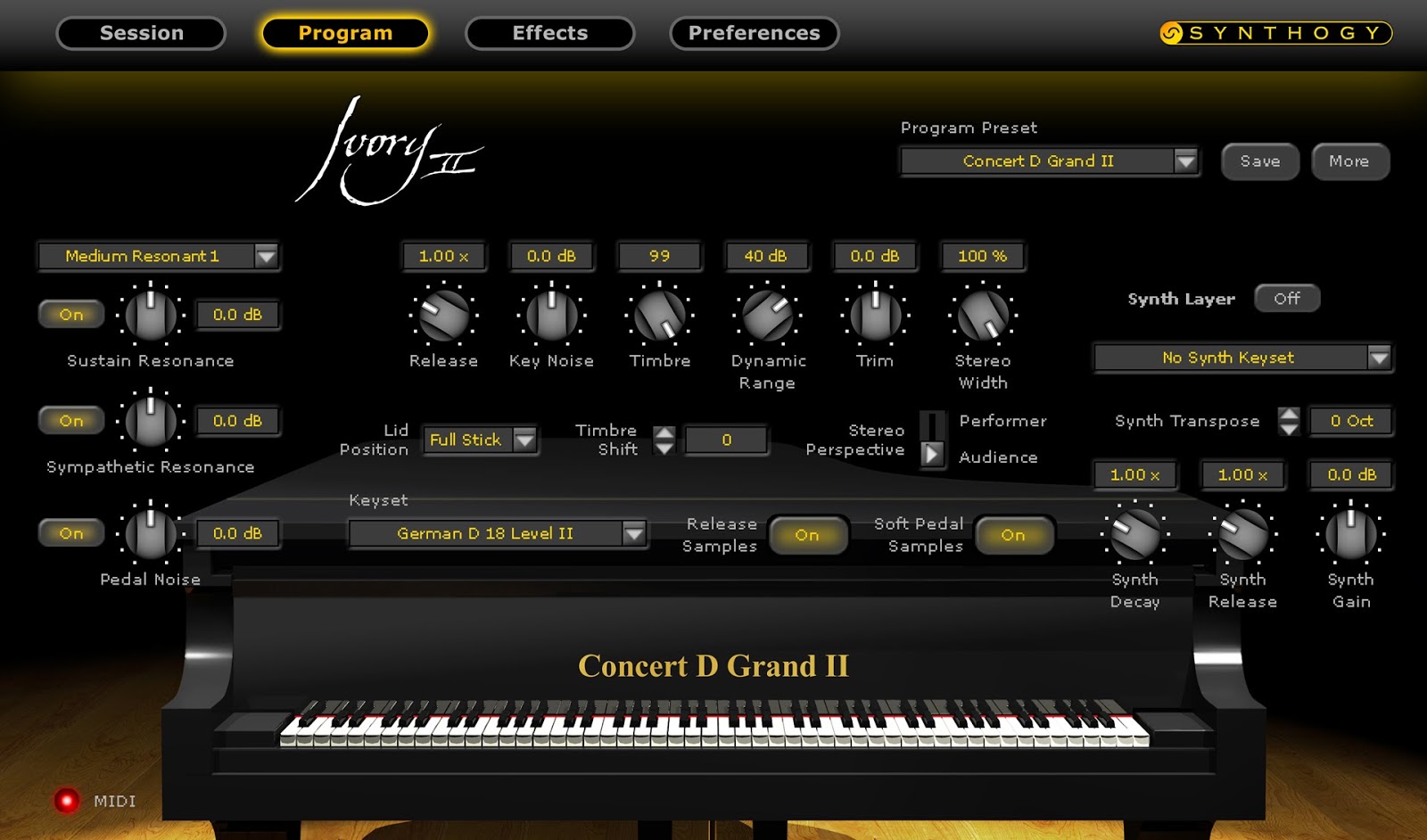
Luckily, this piano VST is so good, that it’s worth the hassle of the iLOK device, and the hard drive space if you can spare it. It can run standalone, or within your DAW. When you open it up, there are menu buttons in the top left that let you access the main edit panels of Synthogy Ivory II. The Session menu lets you play with the velocity mapping, amongst other things. The Program screen has settings like sympathetic resonance, pedal and key noise, lid positions, and many more. The Program screen also has a setting to turn on the Synth Layer, which adds things like lush, warm pads and strings to your piano for added versatility. The Effects screen is exactly what it sounds like (Equalizer, Chorus, Ambience/Reverb). It doesn’t have distortion or anything crazy like Addictive Keys, but we don’t consider that a must-have by any means. There’s a tremendous amount of complexity here, honestly there’s not much you cannot do, and the good thing is that everything is easily accessible within these 3 main menus. “What you see is what you get,” as they say. For live performance you can easily map any editable parameter to a button/knob/slider on your MIDI controller keyboard to affect the sound on the fly.
The Synthogy Ivory II Grand Pianos collection sounds phenomenal. The pianos are rich and complex, extremely expressive, and respond nicely to your playing. Because of the many GB of samples that make up the backbone of Ivory II, switching between presets takes a moment to load new samples, which is slightly irritating.
All in all, Synthogy Ivory II Grand Pianos is fantastic, and while the differences between all these fantastic piano plugins we’re listing can be subtle, this one might just be the best sounding one when it comes to realism. Unfortunately you have to put up with some annoyances - the huge file size, the iLOK, sluggish load times between presets, and the slightly higher price tag. If those aren’t deal breakers for you, Synthogy Ivory II Grand Pianos gives you nearly limitless editability, a straightforward interface, and sounds from prestigious Bösendorfer, Steinway, and Yamaha grand pianos.
- “Having the Yamaha, Steinway, and Bösendorfer samples is awesome. I have a classical piano background and I haven't found anything better. Downsides are the price and the FUCKING ilok dongle.”
- “I grew up playing my parents baby grand and when I moved out it sucked not being able to have that true rich piano sound on my e-piano. Now I use my e-piano and my laptop running Ivory and often use headphones and it is a dream. It really does have the most realistic sound from everything I have heard.”
- “Concerto D (with a lo pass filter). So beautiful. Hate the fact that I had to plug YET ANOTHER usb licensing device into my computer though... So dumb.”
- “Yamaha C7. Probably the best piano VST I've ever used.”
- “…markedly superior to the ones I have played (many) if you are an experienced pianist.”
- “I haven't heard anything else come close if realism is your main interest.”
Best Free Piano Vst Plugins For Ableton Live
Similar Gear Guides
11 Best Studio Headphones of 2020
Best Audio Interfaces
Best Studio Monitors
Best Piano Vst Plugin Fl Studio
Best Digital Pianos
7 Best MIDI Keyboards of 2020
Best Keyboard Amp
Comments 4
The Best Piano Vst Plugins
I just did a table with ALL vPianos out there, hope you'll like it:https://docs.google.com/spreadsheets/d/15HpaLkKSn0I4mhlAh5FZvGtxeFE-ZWW-CswqN2rKCyY/edit?usp=sharing
over 3 years agoThanks you a lot for article.Btw if someone interested in piano samples try to find some deep sounds here :https://www.lucidsamples.com/hip-hop-samples-packs/68-vinyl-cut-chords-download.html
over 3 years agoThanks @roman_dreyer for your useful list!It is incomplete: i just added other 20 pianos... ;-)
about 3 years agoI updated table with all pianos. Most of these I really own and I think the 5 top piano in this article are not my preferred.https://drive.google.com/file/d/1Pxk49XgA1jPAhd1vAojuJmfhsu0I4Dms/view?usp=sharing
about 3 years ago